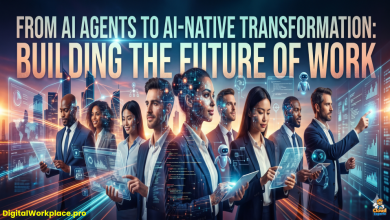
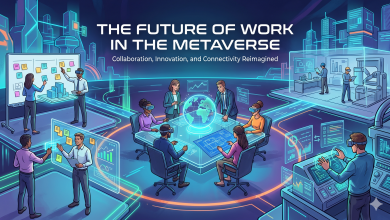
 The future of work stands at a historic inflection point.
Artificial intelligence is no longer a futuristic concept but a pervasive force reshaping tasks, roles, organizations, and entire labor markets.
As generative AI and autonomous agents advance rapidly, economies face both unprecedented productivity gains and profound questions about job displacement, skill obsolescence, inequality, and human purpose in an automated world.
Historical Parallels and Acceleration
Technological revolutions have always transformed work. The Industrial Revolution displaced artisans while creating factory jobs and urban economies.
The computer age automated routine administrative and manufacturing tasks, boosting efficiency but polarizing labor markets toward high-skill and low-skill roles. Today’s AI wave differs in speed and scope: it targets cognitive work—writing, analysis, coding, customer service, even creative ideation—once considered uniquely human.
Recent analyses suggest that 50-55% of jobs in advanced economies like the US could be reshaped by AI within the next 2-3 years, with 10-15% at higher risk of significant substitution. Globally, estimates point to hundreds of millions of jobs exposed to automation, though net effects include substantial job creation in new fields.
The World Economic Forum’s projections indicate that while some roles may be eliminated, others—particularly those involving AI oversight, complex problem-solving, and interpersonal skills—will expand, potentially yielding a net positive in employment by 2030.
The pattern is not uniform replacement but augmentation and reconfiguration. AI excels at pattern recognition, data processing, and repetitive execution. Humans retain advantages in judgment under uncertainty, ethical reasoning, creativity, empathy, and adaptive leadership. Successful organizations will treat AI as a collaborator rather than a pure substitute, redesigning workflows around “human-in-the-loop” models where machines handle scale and speed, and people provide direction, context, and innovation.
Emerging Trends Shaping Tomorrow’s Workplace
Several interconnected shifts define this transition:
- Hybrid and Flexible Models: Post-pandemic remote and hybrid work accelerated digital collaboration tools. AI now enhances this further through smarter scheduling, real-time translation, automated meeting summaries, and virtual assistants. The traditional 9-to-5 office is giving way to outcome-focused, location-agnostic arrangements, though challenges around culture, mentorship, and serendipitous innovation persist.
- The Gig and Project-Based Economy: Platforms powered by AI matching algorithms are expanding freelance and gig opportunities. Workers increasingly stitch together portfolios of roles—combining part-time employment, freelancing, and entrepreneurial ventures. This offers flexibility and autonomy but raises issues of income stability, benefits access, and worker protections. By the late 2020s, a significant portion of the workforce in developed nations may engage in gig or hybrid careers.
- Skills Revolution: Routine cognitive and manual tasks face the greatest pressure. Demand surges for AI literacy, data fluency, prompt engineering (in the near term), systems thinking, emotional intelligence, and lifelong learning capabilities. Entry-level positions in exposed fields are already seeing reduced hiring in some analyses, underscoring the urgency of reskilling and upskilling at scale. Education systems and employers must pivot from static credentials to dynamic, verifiable skills and adaptability.
- Productivity vs. Distribution: AI promises substantial GDP growth through efficiency gains—potentially 7% or more globally according to some forecasts. Yet the benefits risk concentrating among capital owners and high-skill workers unless societies invest deliberately in broad-based opportunity, including retraining programs, inclusive innovation, and policies that support workers in transition.
- New Job Creation: History shows technology creates roles we cannot yet fully imagine: AI ethicists, human-AI collaboration designers, synthetic data curators, sustainability integrators leveraging AI insights, and roles in personalized education or healthcare augmented by intelligent systems. The challenge lies in preparing people to fill them.
Anxiety is understandable. Surveys show growing worker concern about job security, and tech sector layoffs have sometimes been linked to AI-driven efficiencies. However, evidence also points to complementarity: regions and firms aggressively adopting AI skills often see broader labor market resilience when paired with human capabilities.
London’s Response: The AI and Jobs Taskforce
Against this backdrop, London is taking proactive steps. Mayor Sadiq Khan recently announced the formation of a new London AI and Jobs Taskforce (also framed as the AI, Jobs and Opportunity Taskforce), chaired by Baroness Martha Lane-Fox. The taskforce will examine AI’s impact on employment across the capital, recommend actions to help Londoners acquire relevant skills, and ensure the technology drives inclusive, broad-based growth rather than exacerbating divides.
Baroness Lane-Fox brings deep credibility to the role. As co-founder of lastminute.com in the late 1990s dot-com era, she has firsthand experience navigating technological disruption and building digital businesses.
A pioneering technology entrepreneur, philanthropist, and public servant, she has long advocated for technology that serves society broadly—emphasizing inclusion, ethical deployment, and opportunity for all. Her appointment signals a commitment to thoughtful governance of AI’s workplace effects, drawing on lessons from previous tech waves while addressing the unique pace and power of generative systems.
The taskforce arrives at a pivotal moment for London, a global financial, creative, and tech hub with a diverse economy. Sectors like professional services, media, finance, and logistics face varying degrees of transformation. Success will require balancing innovation with support for workers—through education partnerships, targeted reskilling initiatives, business incentives for responsible AI adoption, and policies fostering quality job creation.
By focusing on “opportunity” alongside jobs, the effort acknowledges that the future of work must prioritize not just employment numbers but meaningful, sustainable livelihoods.
Toward a Human-Centered Future
The future of work will not be determined by technology alone but by the choices societies make today. Will we design AI systems that augment human potential and distribute gains widely? Or allow unchecked automation to widen gaps? Key principles for navigating this include:
- Lifelong learning ecosystems: Integrating AI tools into education and continuous professional development.
- Inclusive innovation: Ensuring underrepresented groups participate in AI development and benefit from its applications.
- Ethical guardrails: Addressing bias, transparency, and worker rights in algorithmic management.
- Experimentation and adaptation: Piloting new social contracts, such as portable benefits for gig workers or incentives for human-AI teaming.
London’s taskforce, under Baroness Lane-Fox’s leadership, offers a localized laboratory for these ideas—one that could inform national and international approaches. As AI capabilities continue advancing, cities and nations that proactively shape the transition—rather than react to it—will be best positioned to harness its upsides.
The scene is set: rapid technological change meeting deliberate policy focus. The coming years will test our collective ingenuity in reimagining work as a source of purpose, prosperity, and human flourishing in the age of intelligent machines. The outcomes depend on foresight, investment in people, and a commitment to ensuring AI serves humanity, not the reverse.