Beyond the Search Bar: 5 Ways Google’s New “Workspace Intelligence” is Redefining How We Work
Google launches Workspace Intelligence, an AI-powered upgrade enhancing Gmail, Docs, and Meet with smarter search, content generation, and real-time collaboration tools for boosted productivity.

 For most professionals, the workday isn’t just about completing tasks; it’s about paying an exhausting “context tax.”
We spend hours every week toggling between browser tabs, hunting for specific charts buried in email threads, and stitching together fragmented data from disparate chat conversations.
In this old model, our tools act merely as a passive “canvas,” leaving the heavy lifting of organization and synthesis entirely to the human user.
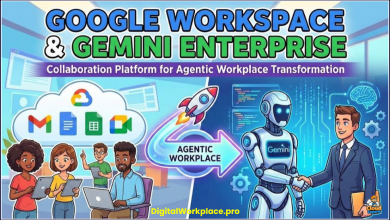
Google has launched Workspace Intelligence, an AI-powered upgrade enhancing Gmail, Docs, and Meet with smarter search, content generation, and real-time collaboration tools for boosted productivity, marking a fundamental shift in this dynamic.
It is a transition from tools that wait for instructions to a system that understands your goals. By breaking down “context walls,” Workspace Intelligence moves beyond simple connectivity to offer a real-time, unified understanding of your work.
Takeaway 1: The Death of Toggling — A Unified Command Line in Chat
Communication apps have traditionally been places where we talk about work. “Ask Gemini in Chat” changes that, transforming Google Chat into a unified command line for your entire professional stack. This isn’t just a chatbot; it’s an orchestration hub where you can simply “state your goal” in natural language and watch Gemini deliver the finished result directly into the conversation.
By utilizing expanded third-party connectors for tools like Salesforce, Jira, and Asana, Gemini can pull data and execute tasks across your professional ecosystem. Whether it’s a “daily briefing” that proactively surfaces urgent action items or a command to generate a new document based on a recent thread, the system handles the manual coordination for you.
“Workspace Intelligence… inherently understands complex semantic relationships within your Workspace apps (such as Docs, Slides, or Gmail) content, your active projects, your collaborators, and your organization’s domain knowledge.”
Analysis: This is the literal “death of toggling.” By acting as a capable agent—one of the three pillars of Google’s AI-first trifecta—Chat becomes the central interface for work. It shifts the user’s role from “information gathering” to “directing outcomes,” using Workspace skills to bridge the gap between communication and execution.
Takeaway 2: One-Shot Creation from “Blank Page to Brilliance”
The “blank page” hurdle is being dismantled by “one-shot” creation capabilities across Docs, Sheets, and Slides. In Slides, users can now generate full, editable presentations that strictly adhere to company templates and brand styles in a single step. In Docs, Gemini has evolved into a sophisticated collaborator that can triage and respond to comments, edit content based on feedback, and even edit multiple images simultaneously to ensure visual consistency across a document.
The most impressive leap, however, is in Sheets. Google has set a “state-of-the-art benchmark” for spreadsheet intelligence with Gemini’s ability to perform multi-step construction. It can build and edit entire spreadsheets by synthesizing data from your files, emails, and the web.
Analysis: This demonstrates “true personalization.” Workspace Intelligence learns your unique voice and formatting preferences, ensuring that “one-shot” drafts aren’t just generic templates but grounded, brand-compliant assets. This move toward automated “information gathering” ensures that the AI-first enterprise starts every project with a significant head start.
Takeaway 3: The AI Inbox and the End of the “Email Hunt”
Information overload is most acute in the inbox. Workspace Intelligence introduces the “AI Inbox” and “AI Overviews in Gmail search” to replace the manual “email hunt” with synthesized intelligence. Instead of digging through 20-message threads to find a decision or a date, Gemini provides a concise summary of the key points.
“Workspace Intelligence turns your scattered emails, chats, and files into a cohesive knowledge graph.”
Analysis: This feature is powered by “situational awareness” and advanced Gemini reasoning. Unlike traditional search, which is often chronological, this system uses deep context to determine what is most important to you based on your active projects and stakeholders. It’s the second pillar of the AI-first trifecta—deep context—turning a list of messages into a prioritized knowledge base.
Takeaway 4: Drive is No Longer Just Storage; It’s a Knowledge Base
Google Drive is shedding its identity as a “passive storage container” to become an “active knowledge base.” The introduction of “Drive Projects” allows teams to centrally organize files and emails, giving both collaborators and Gemini the full context of a project. With “Ask Gemini” now generally available in Drive, users can get detailed insights and track project progress across all stored files using natural language descriptions.
Analysis: This shift represents a transition from a folder-based model to a context-based model. When Drive becomes “project-aware,” it provides the “deep context” necessary for agentic work. It allows the AI to track progress and provide overviews that were previously impossible when files were treated as isolated, disconnected objects.
Takeaway 5: The “Agentic” Security Shield
For an enterprise to adopt autonomous AI agents, security is the ultimate requirement. Google’s framework is built on the principle that “your data is your data.” This means your information is not reviewed by humans, used for advertising, or used to train external models without permission.
Crucially, Google provides granular admin controls and technical safeguards:
- Client-side encryption: This gives organizations the power to authoritatively deny access to sensitive data from any entity, including Google.
- Data residency locking: Users can lock data processing and storage to the US and EU, with support for Germany and India coming in the future.
Analysis: Security and governance are the third and final pillars of the AI-first trifecta. This “security shield” is what makes agentic work viable at scale. By keeping intelligence within the “secure confines of the Workspace platform,” Google ensures that privacy isn’t a trade-off for productivity.
Conclusion: Toward a Boundless Enterprise
The era of the “context tax” is coming to an end. By combining “Google-grade search and indexing” with Gemini’s advanced reasoning, Workspace Intelligence delivers a system that doesn’t just store your information but understands it. This “AI-first trifecta” of capable agents, deep context, and world-class security provides a reliable enterprise infrastructure that competitors will struggle to match.
As these tools move from being a canvas for our input to a partner for our intent, the very nature of professional output changes. We are moving toward a boundless enterprise where the heavy lifting of coordination is handled by intelligence, leaving humans free to focus on strategy and creativity.
Closing Thought: How would your workday change if your tools finally understood your intent rather than just your input?