Ryan Roslansky: Turning AI Anxiety into Skills for the Future of Work
A lot of people are asking the same question right now: Will I be left behind?

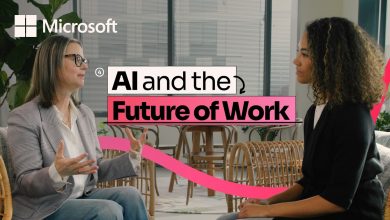
 In this episode of Tools and Weapons, Microsoft’s Vice Chair and President Brad Smith sits down with Ryan Roslansky, CEO of LinkedIn and Executive Vice President at Microsoft, for a practical conversation about AI, the future of work, and what people can do now to stay ahead.
Drawing on ideas from his new book, “Open to Work: How to Get Ahead in the Age of AI,” Ryan shares a framework for thinking about careers in the era of AI that starts not with job titles, but with tasks.
Together, Brad and Ryan explore how work can be divided into three categories: tasks AI will automate, tasks AI can augment, and tasks that remain deeply human.
They discuss why the most valuable skills may be the ones hardest to automate, including curiosity, courage, communication, and compassion. They also talk about how AI can become a genuine thought partner at work, helping people save time, sharpen ideas, and focus more energy on judgment, relationships, and creativity. Ryan explains why careers are no longer ladders but climbing walls, why cross-disciplinary roles are emerging, and why adapting to AI is as much a mindset shift as a technical one.
This is a conversation for anyone early in their career, mid-career, or helping the next generation navigate a changing workplace. It’s about turning anxiety into action and using AI to build a more meaningful future of work.
Key Themes and Structure
The discussion reframes work around tasks rather than traditional job titles or roles, dividing them into three categories:
- Tasks that AI will automate (e.g., routine summarization or translation).
- Tasks that AI can augment (e.g., using tools like Copilot as a “thought partner” to save time, sharpen ideas, draft content, or analyze data faster).
- Deeply human tasks that remain irreplaceable (e.g., building relationships, resolving conflicts, exercising judgment, creativity, and empathy).
They emphasize that the most valuable future skills are often the hardest to automate: curiosity, courage, communication, and compassion (sometimes framed as EQ or “soft” skills). AI should empower people rather than simply outperform them, freeing humans to focus on higher-value, meaningful work.
Major Discussion Points
- Human ingenuity in uncertainty: They use the Apollo 13 mission as a metaphor—technology alone wasn’t enough; creative collaboration and problem-solving by people made the difference. The message is that humans shape how AI evolves, and “failure is not an option.”
- Early adoption pays off: People and organizations who experiment with AI tools now gain advantages in productivity and learning. Community sharing (e.g., LinkedIn tips) accelerates this.
- Careers as climbing walls, not ladders: Traditional linear career paths are outdated. Modern careers involve flexible, cross-disciplinary moves, acquiring adjacent skills, and adapting continuously. LinkedIn data shows success often comes from non-linear paths and AI-enhanced individual contributions (not just climbing into management).
- Three guiding questions for your career:
- Why do you work? (Purpose and motivation beyond pay.)
- What do you uniquely do? (Leverage your distinct human strengths and tasks.)
- Where do you want to go? (Take agency in directing your path.)
- Broader economic and societal view: AI can drive innovation “from all, for all” to tackle big challenges (e.g., climate, health). Every job is changing—skills may shift ~25% every 8 years, potentially up to 70% by 2030—but jobs evolve rather than disappear. New cross-disciplinary roles (“builders”) emerge that combine skills with AI.
- The core debate: Should AI aim to outperform humans (e.g., toward AGI) or primarily empower them? Roslansky and Microsoft lean toward empowerment, using AI as a tool for better work, relationships, and societal good.
Overall Tone and Audience
The tone is optimistic and actionable, aimed at anyone feeling anxious about AI displacing jobs—whether early-career, mid-career, or those guiding others (e.g., parents, educators). It stresses mindset shifts, continuous learning, and viewing AI as a collaborator rather than a threat. The conversation ends on a hopeful note: adapting to AI can lead to more fulfilling, human-centered work.