Beyond Traditional Computing: How AWS WorkSpaces Power the Future Of Work
WorkSpaces decouples the desktop experience from physical infrastructure, enabling true workforce agility in an era where flexibility drives talent retention and productivity.

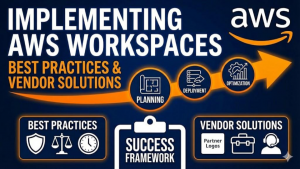 Amazon WorkSpaces, AWS’s fully managed Desktop as a Service (DaaS) solution, represents a pivotal shift beyond traditional on-premises computing toward a flexible, secure, and scalable model for the modern workforce.
As hybrid and remote work solidify as permanent fixtures in 2026—with most organizations blending in-office and remote arrangements—WorkSpaces empowers businesses to deliver high-performance virtual desktops and applications to users anywhere, on any device, without the burdens of hardware procurement, maintenance, or complex VDI deployments.
Traditional computing often ties employees to physical offices or laptops loaded with sensitive data, creating security vulnerabilities, high costs, and administrative overhead.
WorkSpaces decouples the desktop experience from physical infrastructure by hosting everything in the AWS cloud. This enables true workforce agility in an era where flexibility drives talent retention and productivity.
Core Architecture and Deployment Models
Amazon WorkSpaces provides two primary models tailored to different needs:
- WorkSpaces Personal: Persistent virtual desktops for knowledge workers, developers, or power users. Each user gets a dedicated desktop that retains customizations, installed applications, files, and settings across sessions—much like a traditional PC but hosted securely in the cloud.
- WorkSpaces Pools: Non-persistent, pooled desktops ideal for task workers, contact centers, or shift-based roles. These offer cost efficiency through shared infrastructure, with desktops spun up on demand and reset after use.
Both integrate seamlessly with AWS services for identity (e.g., AWS Managed Microsoft AD, Microsoft Entra ID), security, and monitoring.
Users access WorkSpaces via native clients on Windows, macOS, Linux, iOS, Android, ChromeOS, or even web browsers. No VPN is required in many setups, thanks to secure streaming protocols.
Advanced Streaming Protocols for Superior Performance
WorkSpaces leverages two protocols for optimal user experience:
- Amazon DCV (formerly WSP): AWS’s high-performance protocol excels in bandwidth-constrained or high-latency environments. It supports advanced features like multi-monitor setups, 4K resolution, USB redirection (including generic devices), webcam configuration, and optimized media streaming.
- PCoIP: Teradici’s protocol remains available for specific legacy compatibility needs, though DCV has become the preferred choice for most modern deployments due to its superior compression and feature set.
Recent enhancements, including Microsoft Teams optimization (generally available as of early 2026), offload audio, video, and screen-sharing processing to the local device. This delivers native-like HD collaboration with reduced latency—critical for hybrid teams relying on video calls daily.
Other 2025–2026 updates include advanced printer redirection (supporting duplex printing, tray selection, stapling), expanded instance types (100+ options across GPU-accelerated families for graphics-intensive workloads), configurable storage (up to 500GB+), and support for Windows Server 2025 images.
Security and Compliance Built for the Modern Threat Landscape
In a world of increasing cyber risks, WorkSpaces embeds enterprise-grade security:
- Data never resides on endpoint devices—only pixels stream to the client.
- Encryption in transit and at rest.
- Multi-factor authentication (MFA), integration with zero-trust identity providers.
- Granular access controls via AWS IAM and directory services.
- Compliance with standards like HIPAA, GDPR, PCI DSS, and more.
Administrators manage updates, patching, and backups centrally, reducing endpoint vulnerabilities common in traditional setups.
Cost Efficiency and Scalability
WorkSpaces disrupts traditional CapEx-heavy VDI with transparent, pay-as-you-go pricing:
- Hourly billing: Ideal for variable or part-time usage (e.g., contractors).
- Monthly billing: Predictable flat rates for full-time users.
- Recent additions like monthly options for WorkSpaces Core managed instances enhance flexibility for partners (Citrix, Workspot, etc.).
No upfront hardware investments or over-provisioning needed—scale from tens to thousands of users instantly across global AWS regions.
Powering the Future of Work in 2026 and Beyond
As hybrid models dominate—Gallup and other reports show most remote-capable workers prefer flexibility—WorkSpaces aligns perfectly with trends toward distributed teams, global talent access, and resilience against disruptions.
It supports:
- Seamless onboarding for remote hires anywhere.
- Business continuity during crises or natural events.
- Enhanced productivity via low-latency access to powerful AWS-backed resources.
- Sustainability by reducing on-premises hardware footprints.
For graphics-heavy roles (CAD, media editing), GPU-accelerated instances and enhanced protocols unlock cloud-scale performance previously limited to local workstations.
Looking ahead, integrations with AI-driven automation, deeper collaboration tools, and evolving protocols position WorkSpaces as a cornerstone of the intelligent, distributed workplace.
Conclusion
Amazon WorkSpaces transcends traditional computing by making desktops elastic, secure, and location-independent. In 2026, as organizations prioritize agility, security, and employee experience, WorkSpaces provides the infrastructure to power the future of work—enabling teams to collaborate effectively from anywhere while IT maintains control and efficiency. Businesses adopting this cloud-native approach gain a competitive edge in talent attraction, operational resilience, and cost optimization in an increasingly hybrid world.