Google Workspace & Gemini Enterprise: Pioneering the Agentic Workplace Transformation
With advancements in multimodal AI models like Gemini 3.0, organizations are leveraging this integration to automate workflows, enhance decision-making, and foster unprecedented levels of efficiency and innovation.

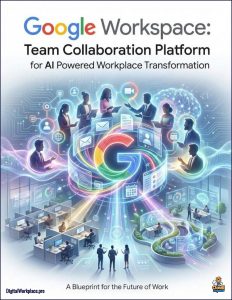 In an era where artificial intelligence is reshaping the fabric of professional environments, Google Workspace integrated with Gemini Enterprise stands at the forefront of this evolution.
This powerful collaboration platform is not merely a suite of productivity tools; it has become a catalyst for agentic workplace transformation—a paradigm where AI agents autonomously handle complex tasks, allowing human workers to focus on strategic, creative, and high-value activities.
With advancements in multimodal AI models like Gemini 3.0, organizations are leveraging this integration to automate workflows, enhance decision-making, and foster unprecedented levels of efficiency and innovation.
This article explores the synergy between Google Workspace and Gemini Enterprise, delving into their core components, agentic capabilities, real-world applications, and the broader implications for the future of work.
Understanding Google Workspace: The Foundation of Modern Collaboration
Google Workspace, formerly known as G Suite, is Google’s cloud-based productivity and collaboration suite designed for businesses, educational institutions, and enterprises.
It encompasses essential tools such as Gmail, Docs, Sheets, Slides, Meet, Drive, and Calendar, enabling seamless real-time collaboration across distributed teams. By 2026, Workspace has evolved significantly, incorporating enhanced storage options, advanced security features, and native AI integrations that go beyond basic automation.
Key editions include Business Starter, Standard, and Plus, as well as Enterprise tiers, each offering varying levels of AI access. For instance, Business plans now include pooled storage expansions and fundamental Gemini AI capabilities for tasks like email drafting and document revision, while Enterprise editions provide enterprise-grade security and broader model access. This scalability ensures that organizations of all sizes can adopt Workspace as a central hub for daily operations.
Gemini Enterprise: The Agentic AI Powerhouse
Launched in October 2025, Gemini Enterprise represents Google’s strategic push into agentic AI for the workplace. It serves as an intranet search tool, conversational AI assistant, and agentic platform that unifies data from across an organization to empower knowledge workers.
Unlike traditional AI assistants that respond reactively, Gemini Enterprise enables proactive, autonomous agents that orchestrate workflows, analyze data, and execute multi-step processes.
At its core, Gemini Enterprise features an intuitive chat interface powered by Google’s advanced models, including Gemini 3.0 Pro, which excels in multimodal understanding—processing text, images, code, and more. It connects seamlessly to systems like Google Workspace, Microsoft 365, Salesforce, and SAP, allowing users to ground AI responses in proprietary data.
A no-code workbench lets non-technical users build and deploy custom agents for tasks ranging from sales analysis to content generation. Pre-built agents, such as those for deep research or coding assistance, provide immediate value, while integration with tools like NotebookLM Enterprise enhances knowledge synthesis.
Gemini Enterprise is available as a standalone add-on or bundled with Workspace plans, with pricing starting at $20 per user per month for Business editions. Higher tiers like Google AI Ultra for Business unlock advanced features, including Gemini 3 Pro Deep Think for complex reasoning and Veo 3.1 for video generation.
The Integration: Enabling Agentic Workplace Transformation
Agentic AI refers to systems that act autonomously, setting goals, planning actions, adapting to changes, and learning from outcomes—much like human agents but at scale and without fatigue.
In the context of workplace transformation, this shifts organizations from hierarchical, task-oriented models to dynamic, outcomes-focused networks where humans and AI collaborate as equals. Google Workspace and Gemini Enterprise exemplify this by embedding agentic capabilities directly into familiar tools.
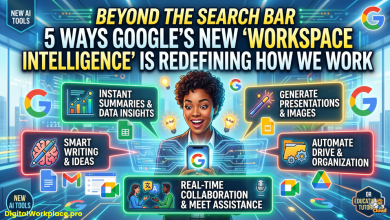
Through Google Workspace Studio, introduced in December 2025, users can create AI agents in minutes using natural language prompts. Powered by Gemini 3, these agents automate multi-step workflows, such as onboarding new employees (pulling data from HR systems, generating documents, and scheduling meetings) or analyzing market trends (ingesting data from Sheets, browsing external sources, and producing reports).
Features like “Ask Gemini in Meet” expand to more languages and plans, providing real-time meeting summaries, action items, and follow-ups. In Calendar, Gemini suggests optimal meeting times based on participant availability and priorities.
This integration fosters an “agentic organization,” where AI handles routine tasks, freeing humans for innovation. For example, in sales teams, agents can orchestrate lead qualification by cross-referencing CRM data with Workspace emails and external web searches, then prioritizing outreach. In HR, agentic AI streamlines talent acquisition, from resume screening to personalized onboarding, enhancing employee experiences.
Key Features and Benefits
The combined platform offers a robust set of features tailored for agentic transformation:
| Feature | Description | Benefit |
|---|---|---|
| Agentic Workbench | No-code tool for building custom AI agents. | Democratizes AI, enabling non-developers to automate processes. |
| Data Connectors | Integrates with Workspace, Microsoft 365, and third-party apps. | Ensures AI decisions are grounded in real-time, enterprise data. |
| Multimodal AI | Handles text, images, video, and code with Gemini 3.0. | Improves accuracy in complex tasks like document analysis or visual content creation. |
| Deep Research Agents | Automates information gathering from hundreds of sources. | Saves hours on research, providing comprehensive reports. |
| Enterprise Security | Includes data privacy controls and compliance tools. | Protects sensitive information in agentic workflows. |
Benefits extend beyond productivity: Organizations report up to 30% time savings on routine tasks, improved decision-making through AI insights, and enhanced collaboration in hybrid environments. Agentic AI also supports workforce reskilling, as employees shift from executors to orchestrators, fostering skills in AI oversight and ethical deployment.
Real-World Applications and Case Studies
In practice, this platform drives tangible outcomes. A marketing team might use Gemini agents to generate campaign content in Docs, analyze performance data in Sheets, and schedule posts via integrated tools—all autonomously. In finance, agents automate invoice processing by extracting data from PDFs, verifying against Drive files, and flagging anomalies.
Early adopters, such as those using Gemini Enterprise since its launch, have seen workflow transformations. For instance, a global retailer integrated it with Workspace to create agents for inventory management, reducing stockouts by 25% through predictive analytics. In education, Workspace with Gemini aids in personalized learning plans, where agents curate resources and track progress.
Challenges and Ethical Considerations
While transformative, agentic AI introduces challenges. Runaway agents could create operational chaos if not properly governed, emphasizing the need for human oversight. Concerns around job displacement persist, though evidence suggests AI augments roles rather than replaces them, creating hybrid positions. Google addresses this with built-in safeguards, like adjustable autonomy levels and audit trails.
Ethically, organizations must prioritize transparency, bias mitigation, and data privacy to build trust in agentic systems.
The Future Outlook: Toward a Fully Agentic Ecosystem
Looking ahead, Google Workspace and Gemini Enterprise are poised to evolve further. Anticipated updates include deeper integrations with emerging technologies like Google’s Universal Commerce Protocol for agentic e-commerce and expanded multimodal capabilities in Chrome. As agentic AI matures, workplaces will become more adaptive, with AI agents handling dynamic tasks in real-time, such as crisis response or innovation ideation.
By 2030, agentic organizations could dominate, with AI contributing to 50% of knowledge work. Google’s platform positions businesses to lead this shift, blending human ingenuity with AI autonomy.
Conclusion
Google Workspace integrated with Gemini Enterprise is more than a toolset—it’s a blueprint for the agentic workplace. By automating the mundane and amplifying human potential, it drives efficiency, innovation, and resilience. For leaders eyeing transformation, adopting this platform isn’t optional; it’s essential to thriving in an AI-first world. As the technology continues to advance, the key lies in strategic implementation, ensuring AI serves as a partner in progress.